01 / Open
Make room for a beginning.
Set your Beej, pot, Sankalp card and water giver in a place suited to your plant. Give yourself a few unhurried minutes.
A little space. A little attention.

Your wish. Your Beej. Your Sankalp.
A personal ritual, a living companion and a 40-day practice—brought together in one thoughtful kit.
Kuchh wishes boyi jaati hain. Choose what matters to you, plant a meaningful beginning, and return with care and action.
Wish · Beej · Sankalp · Ritual · Action · Growth
From the first light to the first small step, every part has a purpose. Explore the ritual at your own pace.
An illustration of the ritual concept01 / Open
Set your Beej, pot, Sankalp card and water giver in a place suited to your plant. Give yourself a few unhurried minutes.
A little space. A little attention.
02 / Light
If you choose, light the brass diya with pure cow ghee. Let it mark a moment of attention before you begin.
Keep the flame on a stable, heatproof surface, away from paper and leaves. Stay with it; extinguish it before leaving.
03 / Write
Write your Sankalp on the paper surface of the wish card. Pair what you hope for with one action you can actually take.
Try: “I nurture learning by making time to practise.”
04 / Plant
Place the prepared Sankalp card and Beej in the pot according to the supplied planting guide. The layered card is designed to break down in soil over time.
Use the supplied, processed material. Do not add raw cow dung or cow urine to the pot.
05 / Offer
Gangajal takes the place of ordinary water in the opening ritual offering, if you choose to include it. Its role here is devotional: a meaningful beginning.
For ongoing irrigation, follow the plant guide and water-quality instructions. Sacred significance does not establish water safety or better growth.
06 / Nurture
Observe your plant, take one useful step toward your intention, and record a reflection. Your 40-day space keeps that practice close.
Water when your plant needs it—not simply because another day has passed.
Kuchh wishes boyi jaati hain. Some wishes are planted.
Begin my 40-day practice →Every element has a purpose
A ritual to begin. Tools to nurture. A digital companion to help you keep showing up.
A living symbol for the intention you choose. Select a plant suited to the space where it will grow.
A home for your Beej and a visible place for your daily practice. Follow the plant-specific planting instructions.
A reusable diya, lit with pure cow ghee, marks the beginning. The light is a ritual of attention, not an air-purification treatment.
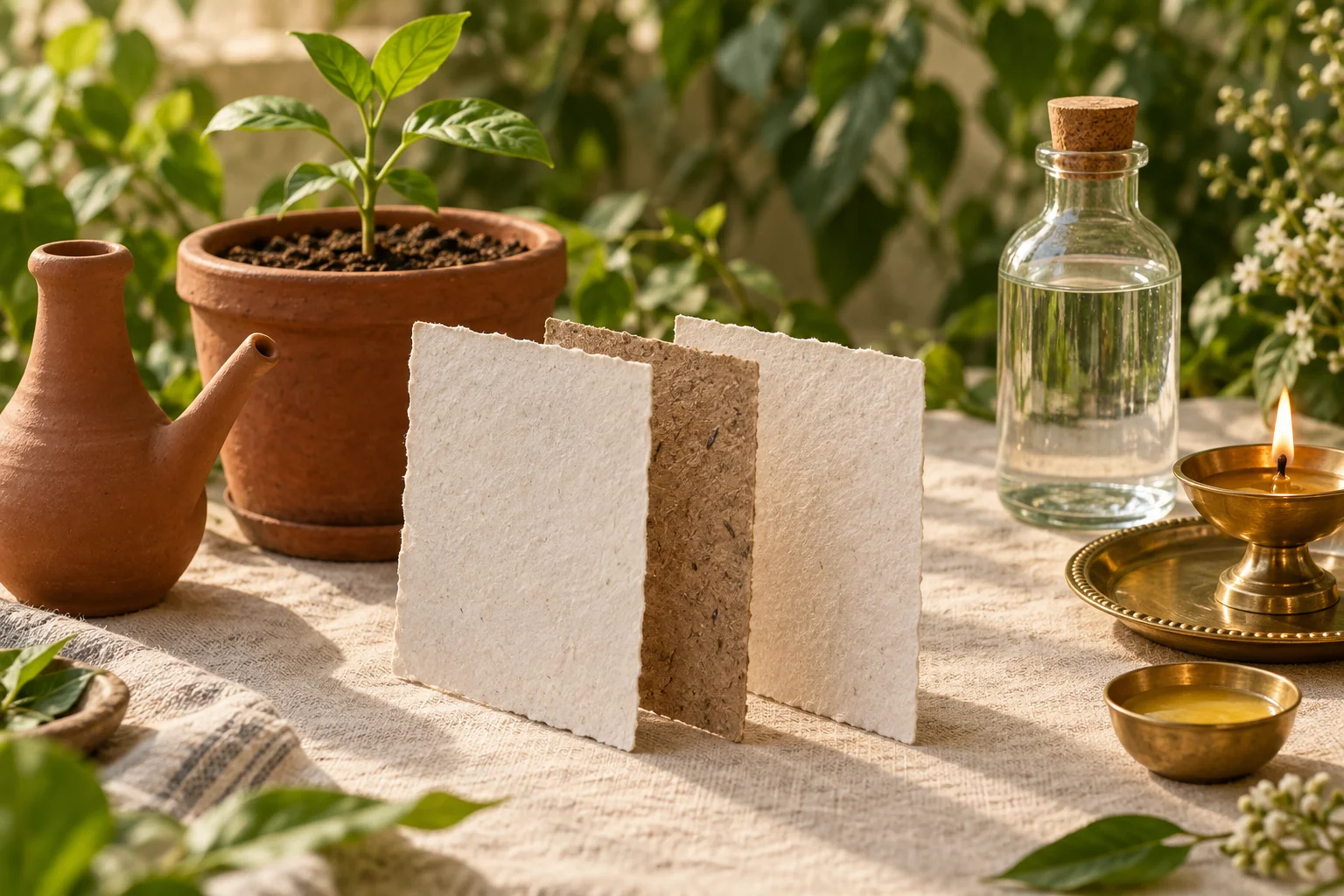
A paper surface for your words and an earth-inspired inner layer. Discover the material concept below.
A dedicated accessory that makes care feel intentional. Observe first; water according to your plant’s needs.
Water from the Ganga, included for its sacred significance in the opening offering. Use according to the ritual and care guide.
A guide to the ritual and a guide to the living plant—because meaningful beginnings need practical care.
Check-ins, a journal, milestones, backups and optional calendar reminders on your phone or computer.
This is the kit concept and ritual specification. Pack quantities, plant form, ghee inclusion and final material instructions will be listed before checkout opens.
The Sankalp card concept
Write the wish you want to nurture on the outer paper. Inside, a cow-dung and cow-urine-based formulation sits between two paper layers—the “sandwich” at the heart of the Sankalp card concept.
Placed in the pot as directed, the card is intended to break down over time. Its meaning stays with you as a commitment you return to each day.
The final formulation needs appropriate processing, plant-compatibility and breakdown testing. No fixed dissolving time is promised. Use only the supplied prepared card; do not add raw cow dung or cow urine yourself. Follow the planting guide and wash hands after handling soil.
Suitable composted material can contribute nutrients, but too much can also harm plants. Read the horticultural guidance ↗
Words → Earth → A daily reminder to act
A sacred beginning
In the opening WishBeej ritual, Gangajal takes the place of ordinary water in your offering. For those who observe the tradition, it connects the moment with the sacred Ganga and gives the beginning devotional meaning.
That meaning is its role in this experience. It does not establish better plant growth, water purity or guaranteed auspicious results. Continue everyday care with suitable irrigation water and your plant’s instructions.
The Ganga’s cultural significance ↗An inspiration for a simple offering
पत्रं पुष्पं फलं तोयं
यो मे भक्त्या प्रयच्छति।
तदहं भक्त्युपहृतम्
अश्नामि प्रयतात्मनः॥Krishna receives a simple offering made with sincere devotion.
Bhagavad Gita 9.26 · meaning paraphrased ↗This verse inspires the spirit of the ritual; it does not prescribe the WishBeej kit.Nature and meaning, understood clearly
A living connection can be meaningful without needing a supernatural explanation.
As suitable organic material breaks down, nutrients can become available in the soil. Plants use light, water and carbon dioxide in photosynthesis and release oxygen.
Explore photosynthesis ↗Your written wish gives the moment meaning. Seeing the plant can remind you to pause, care, and take a practical step toward what matters.
Put your intention into practice ↗The wish is a personal symbol. There is no established evidence that its words, meaning or “vibrations” pass through a plant’s oxygen into your body. WishBeej offers a practice, not a cure or a guarantee.
A randomised study of 291 adults found greater reductions in perceived stress and anxiety in a community-gardening group. It studied community gardens, not WishBeej or a single houseplant. We use that evidence as a reason to make room for nature, not as a treatment claim.
Read the published study ↗Try the experience before you choose
Create a Sankalp you can put into practice. Keep the action small enough to repeat and specific enough to notice.
This preview stays in your browser and downloads only when you choose. It is not submitted with an order.
A thought to carry · Bhagavad Gita 2.47, opening words
कर्मण्येवाधिकारस्ते मा फलेषु कदाचन।Your part is in the action; its fruits are not yours to command.
Our invitation: tend the plant, act on your intention, and allow growth its own pace.
Read the verse and translations ↗Choose the way you begin
Choose quiet ritual or add a speaker and mantra accompaniment. Both connect to the same 40-day digital practice.
Your WishBeej edition
The core WishBeej ritual and your 40-day digital practice, with space for your own words and quiet.
Online checkout is being prepared. Final pack details, delivery charges and terms will be shown before payment.
Give more than a moment
A new chapter. An exam ahead. A friendship worth celebrating. Choose an intention that feels personal, then let the recipient make the practice their own.
Choose with confidence
A Beej gives your intention a living symbol and a reason to return to it. The useful part is the practice you build: learning, preparing, listening, planning or caring. A plant cannot guarantee a job, money, marriage, recovery or another person’s feelings.
No. The diya, Gangajal and mantra are invitations for those who find them meaningful. You can begin with a quiet pause, your written Sankalp and thoughtful plant care.
No fixed time is promised. Breakdown depends on the final material, moisture and growing conditions. The material needs to be verified and the supplied planting instructions followed.
Different plants need different light, space and care. Confirm the supplied species and its suitability before ordering. Peace lily should be kept away from pets and children who may chew it. A lotus needs an aquatic growing setup; tree species need a long-term space plan.
Forty days gives this experience a clear beginning and a period for reflection. It is a designed practice, not a promise that a habit or life outcome will be achieved in 40 days. Continue caring for your plant afterwards.
Yes. The app is available on your phone and computer with no account needed. It stores your practice on your device; use export and restore to move your journal to another device.
Open my Sankalp space →